
Overview
Disclaimer
HBV serology can be complex, and these markers do not always behave exactly as expected. While certain patterns are commonly seen, exceptions occur and individual results may not fit neatly into standard definitions. It is therefore essential to interpret all markers together, alongside the wider clinical picture, rather than relying on any single result in isolation.
Overview
- Hepatitis B (HBV) is a blood-borne virus (BBV) that causes inflammation of the liver
- BBVs are viruses that are carried in blood and blood products
- It can cause scarring of the liver, liver failure, liver cancer and death
- Most adults with acute hepatitis B clear the infection spontaneously. The likelihood of chronic infection is much higher when the infection occurs in infancy or childhood
- Hepatitis B can be passed from person to person through exposure to blood and other bodily fluids such as semen or vaginal fluids
- There is a vaccination for hepatitis B
- Hepatitis B can be chronic or acute
- For transmission to occur the infected blood or bodily fluids need to enter the bloodstream of another person
- The risk of transmission to another person depends on:
- Route of transmission (unprotected sex, IVDU)
- Infectiousness of the virus (hepatitis B is more infectious than hepatitis C and approx. 100 x more infectious than HIV)
- Stage of the infection
- Whether the person is receiving treatment
Key Points for Practice
- HBV can be acute or chronic
- Antigens are produced by the HBV virus
- Antibodies are produced by the body in response, by the immune system
- Many people have no symptoms
- Chronic HBV requires appropriate specialist assessment
- The term “natural HBV” is used to differentiate between exposure to the actual HBV virus, and the vaccination
- CDC guidance states all HBsAG positive people are considered to be infectious, with people who have elevated HBV DNA and/or HBeAG being the most infectious
- If a patient was previously infected with HBV but immunity has waned, they do not usually need a booster vaccine, they develop immune memory. The same applies to patients who have been vaccinated but immunity has waned
Serology:
- HBsAG indicates current infection
- Total anti-HBc indicates current or previous infection
- Anti-HBs indicates immunity, through vaccination or exposure
- Vaccination does not cause a positive anti-HBc
Window Periods:
- Testing window after exposure: the early period where the infection may not be picked up by the test
- Serological window during recovery: HBsAg has disappeared, but anti-HBs has not yet appeared; IgM anti-HBc usually remains detectable
Routes of Transmission
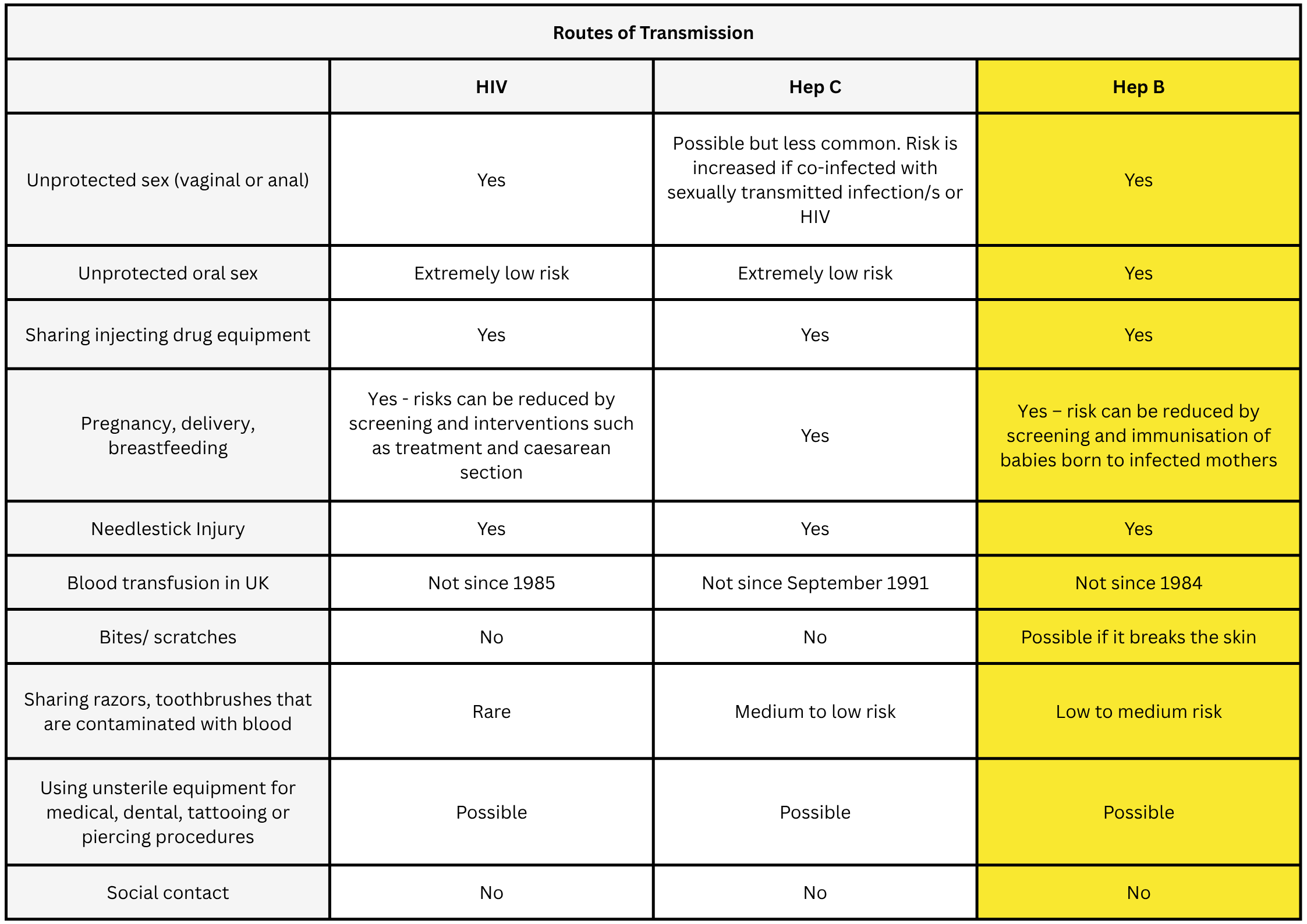
Symptoms and Clinical Presentation
Symptoms usually start about 1 to 4 months after you have been infected with HBV, but they could be observed from as early as two weeks. Some people with acute or chronic hepatitis B may not have any symptoms.
Symptoms can include:
- Fever
- Fatigue or tiredness
- Abdominal pain
- Jaundice
- Dark urine
- Loss of appetite
- Nausea and vomiting
- Joint pain
Testing Recommendations and Window Periods
- BBV testing is recommended 3-6 monthly depending on the person’s risk. If the person is at higher risk, more frequent testing may be recommended. Risk of hepatitis B includes:
- High risk behaviours (unprotected sex, IVDU, sharing injecting equipment)
- Anyone from an area of higher prevalence is higher risk
- Anyone with a clinical presentation associated with a BBV is considered higher risk
- People with multiple sexual partners
- MSM
- People who have experienced sexual assault
- People engaging in transactional sex, selling sex, commercial sex work (CSE)
- The testing window period for hepatitis B is 3-6 months
- A venous blood sample is considered “gold standard” for testing, but hepatitis B can also be tested using a DBST (dry blood spot test)
Hepatitis B Serology: Quick Reference
HBsAG | Anti-HBc | Anti-HBs | IgM anti-HBc | HBeAG | Anti-HBe | HBV DNA | Interpretation |
|---|---|---|---|---|---|---|---|
- | - | - | Susceptible: requires vaccination | ||||
- | + | + | Previous exposure to natural HBV/ resolved infection No action needed if >10 | ||||
- | - | + | Vaccinated No action needed if >10 | ||||
+ | + | - | + | + | Likely acute infection | ||
+ | + | - | - | + | Likely chronic infection | ||
- | + | - | Possibilities: Distant resolved infection Resolving acute infection (window period) False positive Occult hepatitis B |
Hepatitis B Serology and Interpretation
Hepatitis B Markers
Marker | Definition | Positive | Negative |
|---|---|---|---|
HBsAG (HBsAg) (HBV sAg) | Hepatitis B surface antigen | Indicator of current infection | No evidence of current infection from this marker |
Total anti-HBc | Antibody IgM and IgG to the Hepatitis B antigen | Current or previous HBV infection | No evidence of past infection |
Anti-HBc (anti-HB core IgG) (Hepatitis B core) (HBV cAb) | Hepatitis B core antibody | Patient has been exposed to HBV in the past | Patient has never been exposed to HBV |
Anti-HBs (sAb) | Antibody to the hepatitis B surface antigen | Immunity from HBV – vaccination or previous infection ≥10 = immunity <10 = immunity may have waned, discuss with DoD | No indicator of immunity |
IgM anti-HBc | IgM antibody to the Hepatitis B core antigen | Recent/ acute infection is likely | Undetectable in 6-9 months after exposure |
HBeAG | Hepatitis B e-antigen | Generally higher viral replication/ infectivity | HBeAg not detected, high viral replication is still possible |
Anti-HBe | Antibody to the Hepatitis B e-antigen | Generally associated with lower replication/ infectivity, but does not exclude active infection | Anti-HBe not detected, does not establish replication or infectivity |
HBV DNA (Hepatitis B PCR) (Viral load) | Genetic material of the virus | Indicates viral replication, likely current infection | No evidence of infection from this marker |
Vaccination produces anti-HBs but does not produce anti-HBc | |||
Total anti-HBc includes IgM and IgG anti-HBc and indicates exposure to natural HBV | |||
Acute Hepatitis B
- When someone is first infected with hepatitis B, it is called an acute infection
- Acute hepatitis B lasts for less than 6 months
- It is a self-limiting disease (resolves on its own) marked by inflammation of the liver in association with a short infection
- Very rarely, severe acute hepatitis develops which is life-threatening
- Approximately 80-95% of people with acute hepatitis B will recover and become immune
Serologic Markers
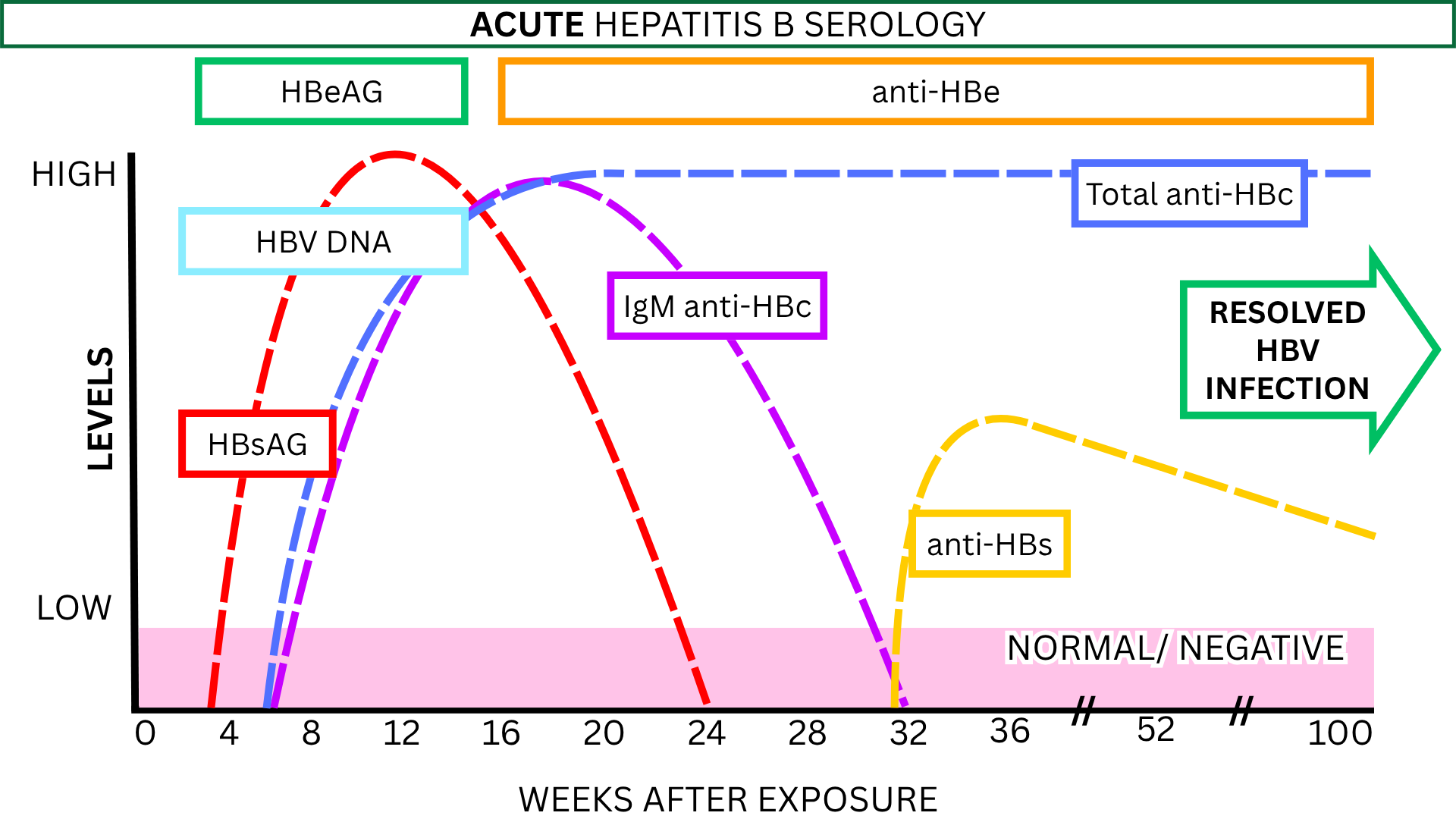
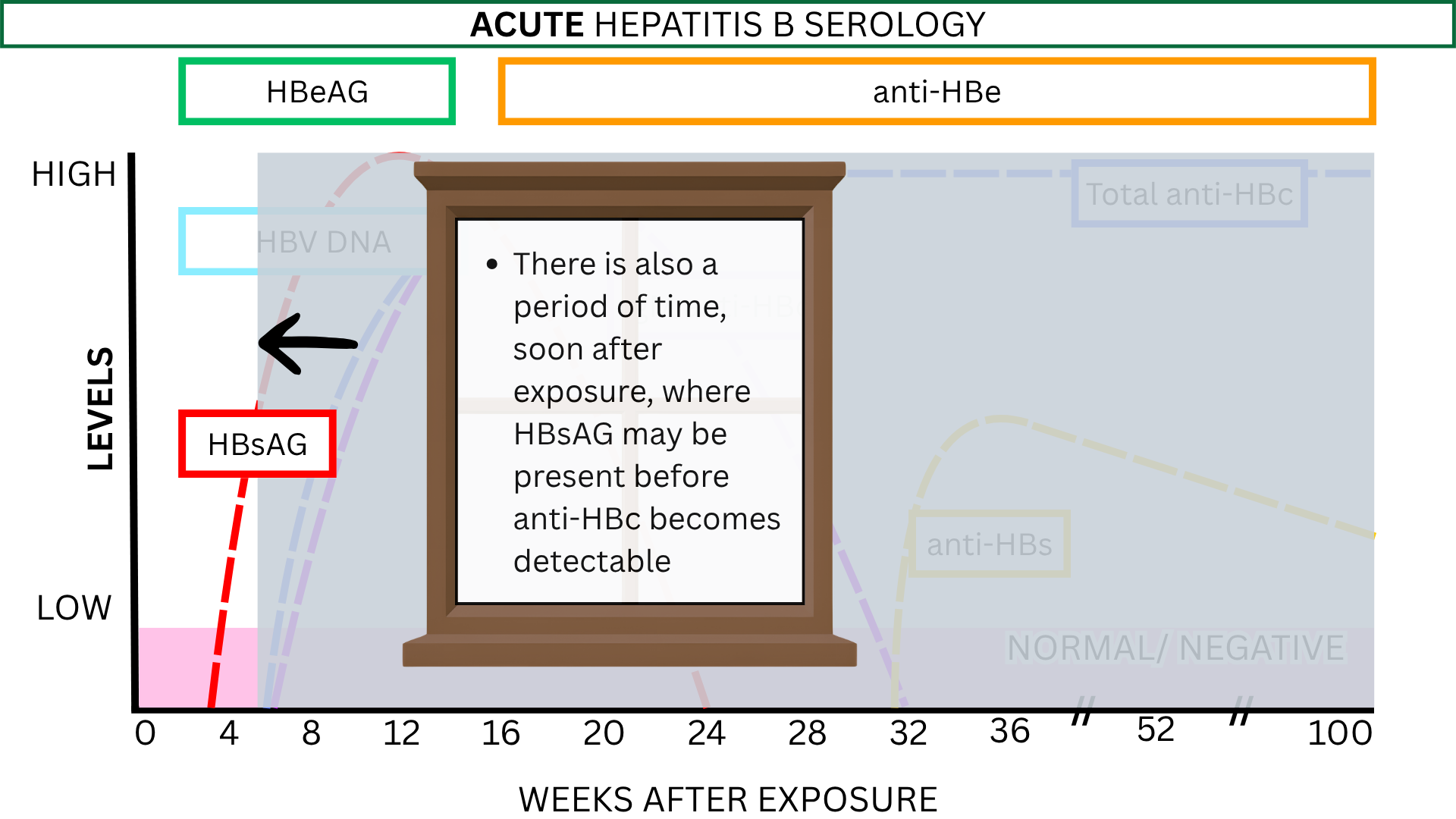
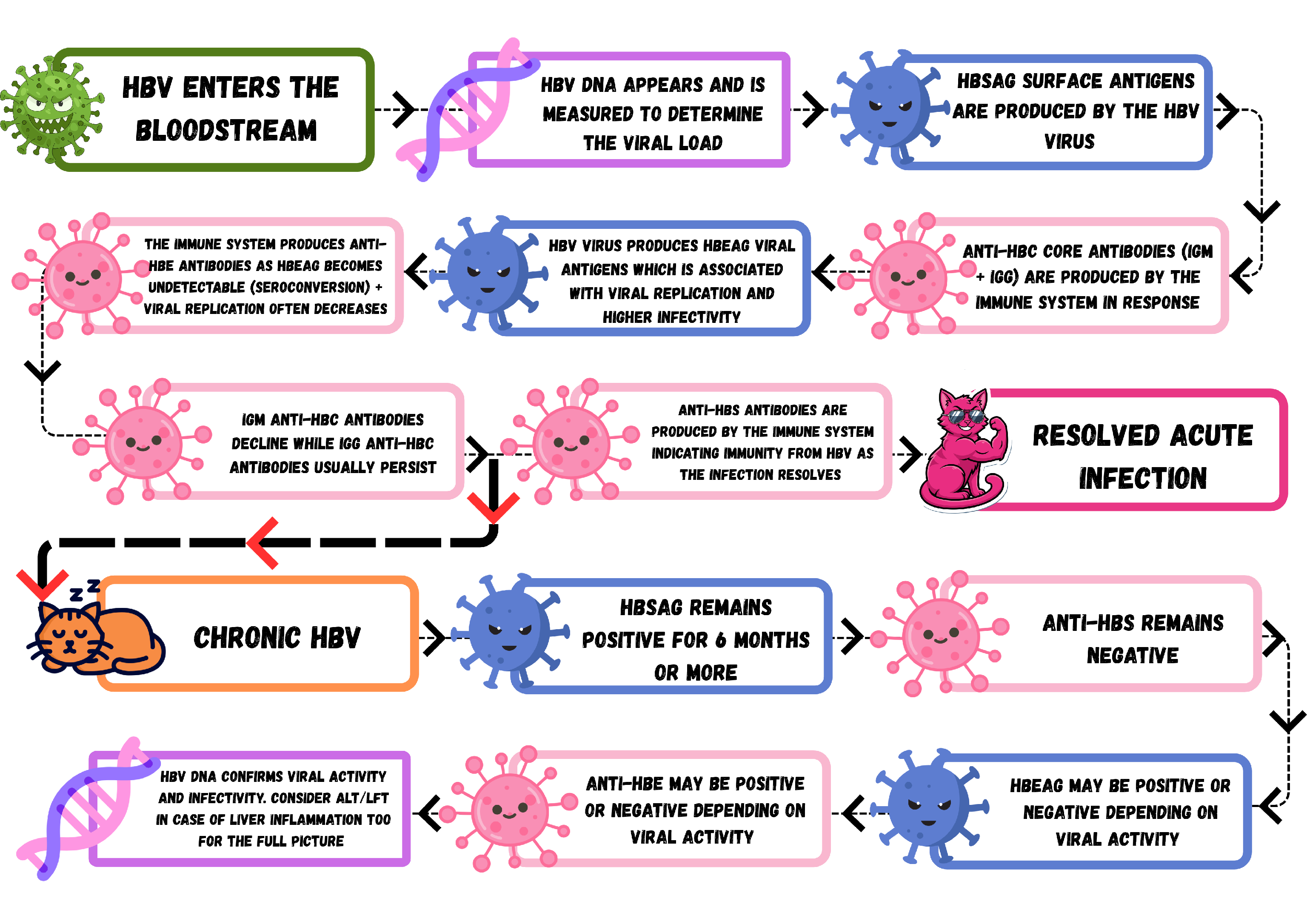
- The first serologic marker to appear in someone infected with HBV is the hepatitis B surface antigen (HBsAG). It can often be detected one month after exposure
- When HBsAG is detected, often HBVDNA (PCR test) is also detected
- The hepatitis B e-antigen (HBeAg) is usually detectable in patients with acute hep B. The presence of HBeAg usually indicated higher infectivity
- Anti-HBe is the antibody to the hepatitis B e-antigen and usually correlates with lower levels of the virus and infectivity
- Generally an acute HBV infection will detect IgM antibody to the hepatitis B core antigen IgM anti-HBc. Positive IgM anti-HBc can also point to a chronic HBV flare or reactivation
- IgM anti-HBc is usually detectable at the onset of symptoms and becomes undetectable within 6-9 months
- The total antibody IgM and IgG to the hepatitis B antigen, referred to as total anti-HBc persists indefinitely as a marker of past infection
- The antibody to the hepatitis B surface antigen (anti-HBs) becomes detectable during recovery and after the disappearance of HBsAG. It generally indicates recovery and immunity from re-infection
Resolving Acute HBV (Window Period)
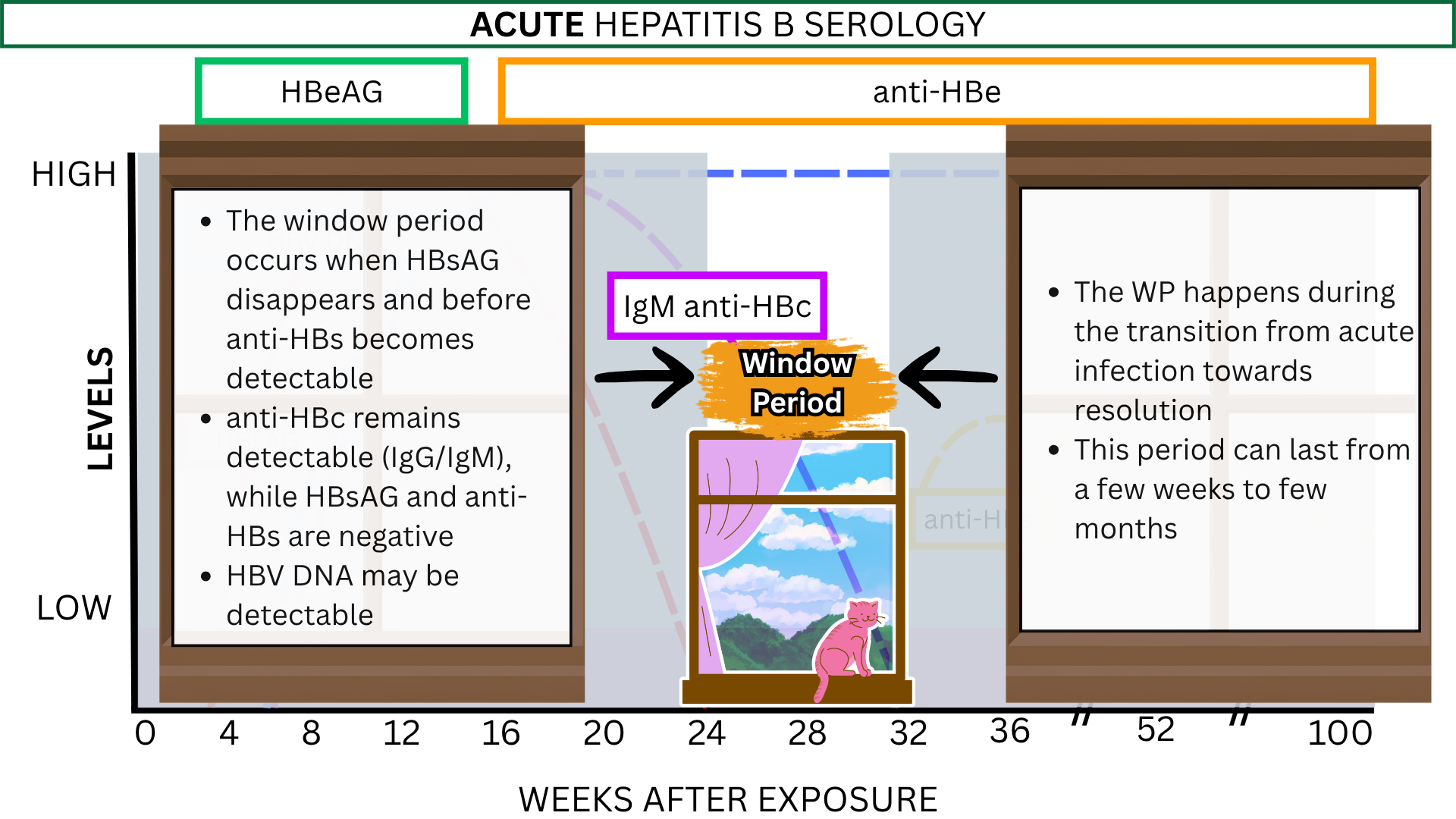
The window period occurs after the disappearance of HBsAG and before the appearance of anti-HBs. During this window period IgM anti-HBc and total anti-HBc are the only serologic markers present. The WP occurs during the transition from acute infection towards resolution, meaning the infection is resolving. This period can last from a few weeks to a few months.
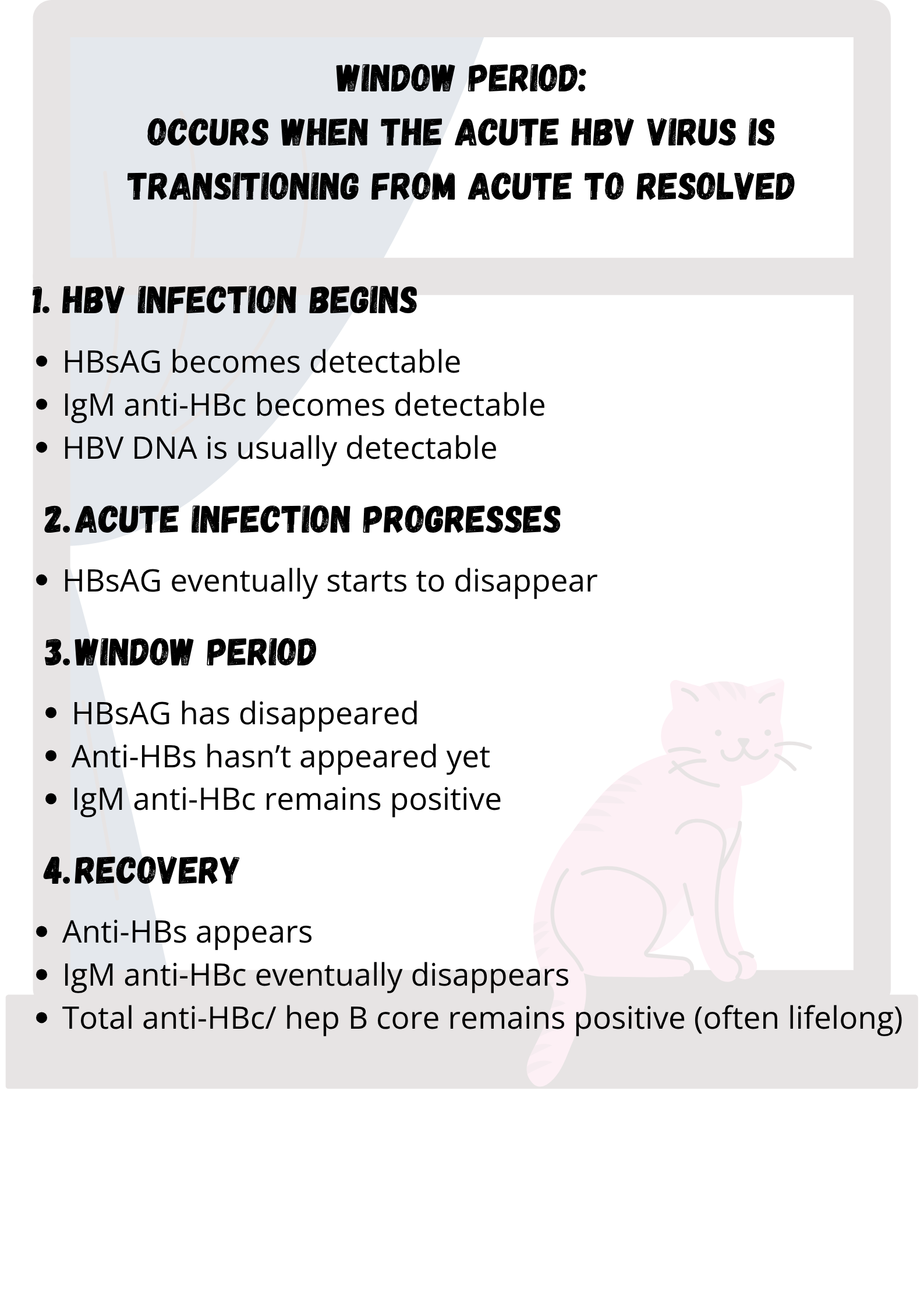
There is also a period of time, soon after exposure, where only HBsAG marker will be present
Acute HBV:
HBsAG | Anti-HBc | Anti-HBs | IgM anti-HBc |
|---|---|---|---|
+ | + | - | + |
Window Period:
HBsAG | Anti-HBc | Anti-HBs | IgM anti-HBc |
|---|---|---|---|
- | + | - | + |
Chronic Hepatitis B
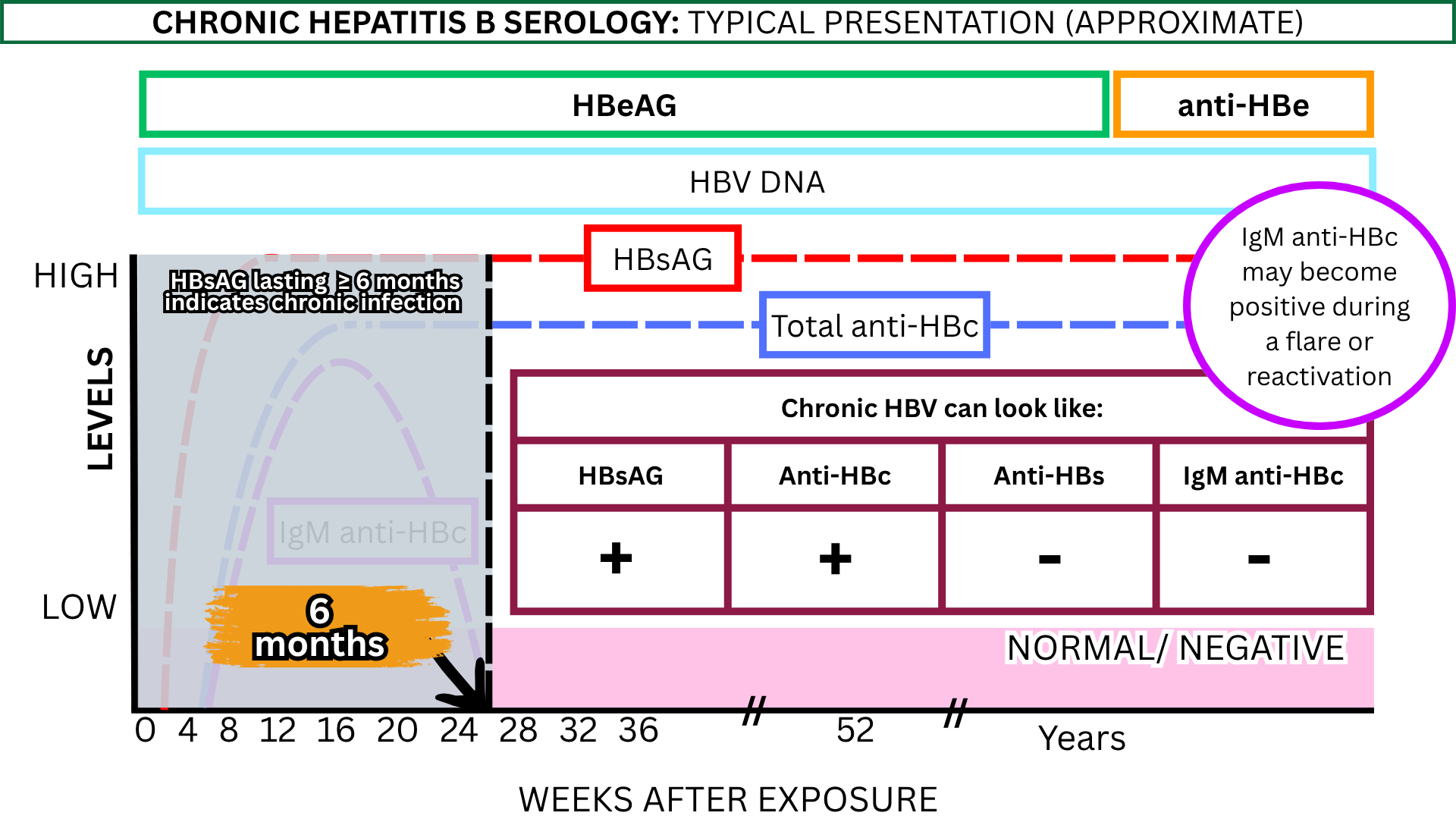
- Chronic hepatitis B is a persistent infection lasting longer than 6 months (HBsAG is present for 6 months or more)
- Most people who develop chronic hepatitis B remain well with no damage to the liver. However, chronic infection has different phases and requires monitoring
- Some people may develop persistent liver inflammation
- Some people may develop fibrosis (scarring of the liver) or cirrhosis (advanced scarring of the liver) which takes years to develop and can lead to liver failure and cancer
Serologic Markers
- Someone with chronic hepatitis B will likely have both HBsAG and total anti-HBc present. They will also have HBVDNA present while the condition is chronic
- Hepatitis B e-antigen (HBeAG) generally indicates higher levels of HBVDNA and therefore greater infectivity
- The antibody to hepatitis B e-antigen (anti-HBe) indicates less infectivity and lower levels of hepatitis B
- Chronic hepatitis B is diagnosed when someone has a positive HBsAG or HBeAG or HBVDNA on at least two separate samples 6 months apart OR if someone has any of these test positive on a single sample and has a negative IgM anti-HBc
HBsAG | Anti-HBc | Anti-HBs | IgM anti-HBc |
|---|---|---|---|
+ | + | - | - |
Previous Exposure to HBV/ Resolved HBV
Patients previously exposed to HBV have usually cleared the infection and gained immunity. Generally, no action is needed, and no vaccines are needed.
- Anti-HBs ≥10 = immunity, no action needed
- Anti-HBs <10 = immunity may have declined/ maybe requires a booster vaccine (Many patients will have retained immune memory even with an anti-HBs <10, and do not require a booster vaccine, discuss with DoD)
HBsAG | Anti-HBc | Anti-HBs |
|---|---|---|
- | + | + |
Vaccination
Serologic Markers
- Successful vaccination will produce anti-HBs of 10 milli-international units per millitre (mIU/ml) or more, 1-2 months after vaccines have been completed
- HBsAG may be transiently positive for 2-3 weeks following vaccination
- Positive anti-HBs indicates immunity after vaccination. The antibody levels will naturally decline over time without repeat exposure to HBV. Immunity is likely to be maintained even if levels decline below 10mIU/ml
- The vaccine does not contain the core antigen, so does not cause anti-HBc positivity
- Anti-HBs ≥10 = immunity, no action needed
- Anti-HBs <10 = immunity may have declined/ maybe requires a booster vaccine (Many patients will have retained immune memory even with an anti-HBs <10, and do not require a booster vaccine, discuss with DoD)
HBsAG | Anti-HBc | Anti-HBs |
|---|---|---|
- | - | + |
HBeAG Seroconversion
Seroconversion is when the immune-marker pattern changes because the immune system has responded to the virus.
HBeAG seroconversion is when HBeAG disappears and anti-HBe appears, showing an immune response.
- HBeAG seroconversion generally indicates better viral control rather than viral clearance
- HBeAG seroconversion generally indicates a resolving acute infection, although HBsAG and anti-HBs are better indicators and should also be considered
- HBeAG seroconversion can also occur when chronic HBV is transitioning to a less active phase of infection
- Some patients can develop HBeAG-negative chronic HBV where they can still be infectious
- HBeAG is associated with higher viral infectivity, and anti-HBe is associated with lower viral infectivity. However, to determine viral infectivity, you must also look at HBV DNA and ALT/LFT for the full picture
HBsAG | Anti-HBc | Anti-HBs | IgM anti-HBc | HBeAG | Anti-HBe | HBV DNA |
|---|---|---|---|---|---|---|
+ | + | - | - | - | + | + |
False Positive core AB
A false positive can occur when:
- Assay limitations (most common): No test is 100% specific. Modern assays are very good, but occasional non-specific binding can occur (the test is designed to "stick to" hepatitis B core antibodies if they are present. Occasionally, it sticks to something else by mistake) producing a positive anti-HBc result in someone who has never had hepatitis B. This is more likely when:
- HBV prevalence is low
- The person has no risk factors
- The anti-HBc level is very weakly positive
- Cross-reacting antibodies: other antibodies in the blood can react with the test
- Lab technical error
HBsAG | Anti-HBc | Anti-HBs |
|---|---|---|
- | + | - |
An assay is the laboratory test method used to measure or detect something e.g. different kits, machines or testing methods
A false positive is most likely when:
- Patient is low risk for HBV
- No indication of liver inflammation
- No history of previous HBV
A false positive is less likely when the patient has risk factors: PWID, born in a high prevalence country, HIV infection. Past resolved infection with waning immunity is more likely.
Occult HBV
Occult hepatitis B is a hidden form of hepatitis B infection where HBsAg is negative, but small amounts of hepatitis B virus remain in the liver. Often there isn't enough detectable surface antigen in the blood to give a positive HBsAg result. Most people have no signs of active infection, but the virus can reactivate if the immune system becomes suppressed and may still have clinical significance. It might look like:
HBsAG | Anti-HBc | Anti-HBs | HBV DNA |
|---|---|---|---|
- | + | +/- | +/- |
HBV DNA
HBV DNA or hepatitis B PCR or Hepatitis B viral load measures how much of the virus is present.
UNDETECTABLE | LOW | Moderate | High |
|---|---|---|---|
<2,000IU/mL | 2,000 – 200,000IU/mL | >200,000IU/mL | |
For HBeAG positive patients a viral load of 20,000IU/mL or greater is often considered significant. While HBeAG negative levels above 2,000IU/mL combined with elevated liver enzymes may indicate active disease | |||
ALT
ALT (alanine aminotransferase) is a marker of liver injury and is one of the tests included in an LFT panel. It is an enzyme found mainly inside the liver cells. When liver cells are damaged, ALT leaks into the blood and ALT rises. When assessing chronic HBV it is important to know whether there is ongoing liver inflammation or injury. This will determine the clinical significance of the infection and whether treatment should be considered. This test helps form a bigger picture of what the HBV virus is doing in the body.
Progression of HBV Infection
Treatment
- Most people clear hepatitis B without treatment
- People with chronic hepatitis B are more likely to need treatment
- Antiviral treatment aims to stop or limit the virus from damaging the liver, it supresses the virus rather than curing it
- It is usually one daily tablet
- The length of treatment depends on how much damage there is to the liver – treatment may last years and the patient will require ongoing monitoring
- In Scotland the main treatment options are:
- Tenofovir Disoproxil (TDF) 245mg daily
- Entecavir 0.5mg daily
- Tenovofir Alafenamide (TAF) daily
- Note: Tenofovir is part of PrEP medication, PrEP can suppress the hepatitis B virus
Hepatitis B and PrEP
- HIV PrEP contains Tenofovir Disoproxil and Emtricitabine
- Tenofovir is active against both hepatitis B and HIV
- If someone is being treated for chronic hepatitis B, they can also be prescribed PrEP if they are at risk of HIV. However, if PrEP isn’t taken daily, correctly, if there are missed doses or PrEP is stopped, it can cause a potentially serious hepatitis B flare. The patient would need to be closely monitored and adherence checked regularly
- A patient with chronic hepatitis B and on HIV PrEP should be managed by a hepatitis B specialist service alongside Sandyford
- PrEP should be taken daily, not event-based to prevent a hepatitis B flare
Hepatitis B and HIV
If someone has both hepatitis B and HIV they would generally be treated with a HIV antiretroviral combination that also contains drugs active against hepatitis B. A patient with HIV also co-infected with hepatitis B should be referred to Brownlee for follow up. For example a patient may be prescribed:
- Tenofovir (active against HIV and HBV)
- Emtricitabine (active against HIV and HBV)
- A third HIV specific drug to ensure the HIV regimen is effective